
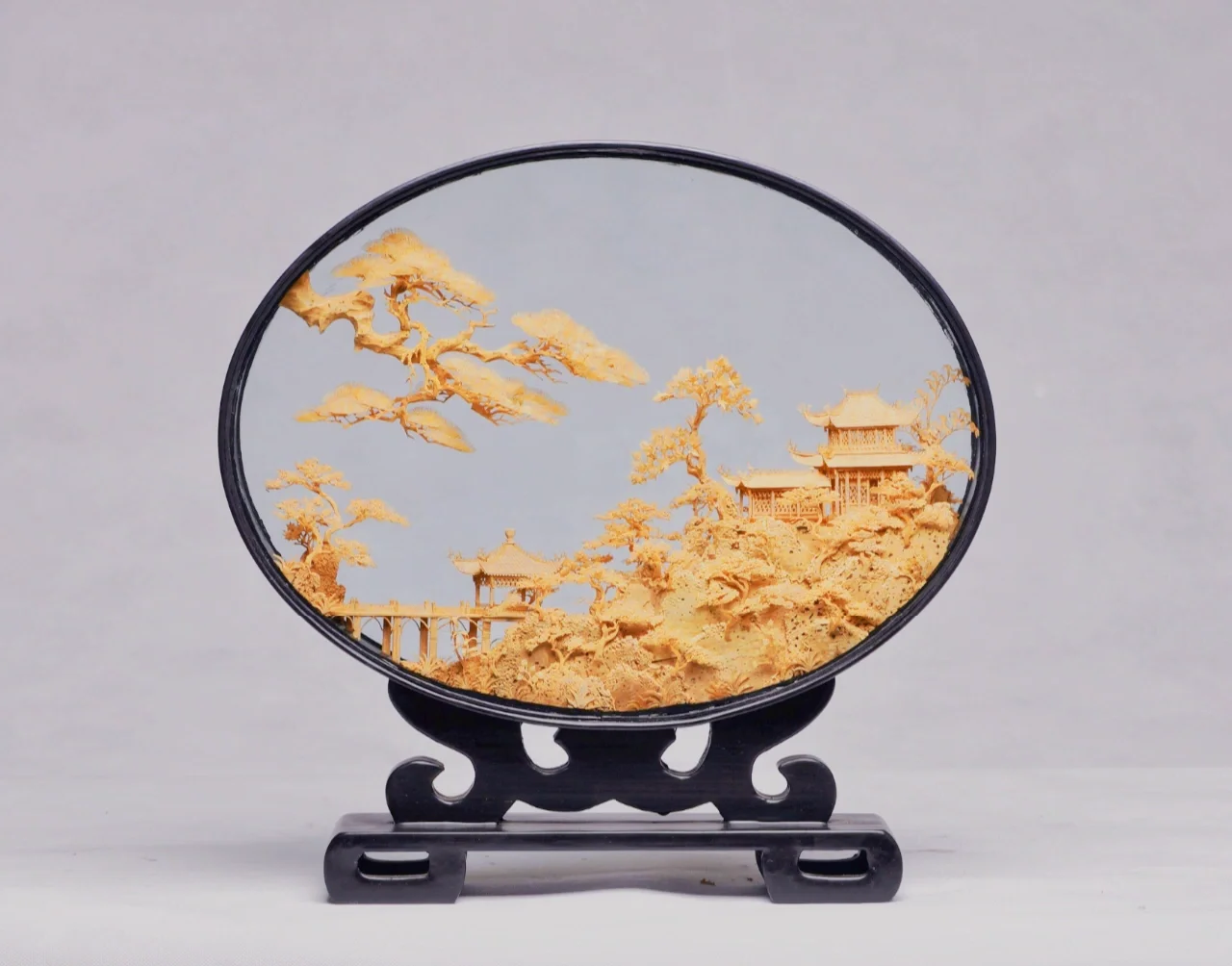
福州软木画是福建福州独有的传统精微雕刻工艺,与脱胎漆器、寿山石雕并称 “榕城三绝”,但相较于后两者,它的大众认知度极低,属于十分冷门的传统工艺门类。它以栓皮栎的天然软木为原材料,凭借特制的细刃刀具精雕细镂,将软木切割成薄如蝉翼的构件,再通过堆贴、拼接、分层组装等多道工序,塑造成层峦叠嶂、亭台楼阁的立体山水景致,被誉为 “无声的立体诗,迷你的山水画”。
Fuzhou cork carving is a traditional exquisite carving craft unique to Fuzhou, Fujian. Together with bodiless lacquerware and Shoushan stone carving, it is known as the “Three Wonders of Rongcheng”. However, compared with the other two, it has very low public recognition and belongs to a very obscure traditional craft category. It uses natural cork of cork oak as raw material. With special fine-edged carving tools, craftsmen carve cork into cicada-wing-thin components, and then through multiple processes such as stacking, pasting, splicing and layered assembly, they create three-dimensional landscape scenes with layered mountains, pavilions and towers, known as “silent three-dimensional poetry, miniature landscape painting”.
软木画的核心技艺难点在于 “微中造境”,匠人需在毫米级的软木薄片上雕刻出窗棂、砖瓦、松针等精细细节,成品层次最多可达十余层,近景、中景、远景错落有致,无需额外彩绘,完全依托软木本身的天然色泽与雕刻肌理呈现画面质感。传统题材多为福州鼓山、西湖等本地山水与古典园林意境,兼具写实与写意之美。由于制作周期漫长、技艺门槛极高,如今掌握完整软木画全流程技艺的传承人寥寥无几,作品多作为外事礼品与非遗馆藏,普通大众很少有机会接触到这项精巧的中国传统工艺。
The core technical difficulty of cork carving lies in “creating scenery in miniature”. Craftsmen need to carve fine details such as window lattice, bricks and tiles, and pine needles on millimeter-thick cork slices. The finished product can have up to more than ten layers, with well-arranged foreground, middle ground and distant view. No additional color painting is needed, and the picture texture is presented entirely by the natural color and carving texture of the cork itself. Traditional themes mostly include local landscapes such as Fuzhou Gushan Mountain and West Lake, as well as classical garden artistic conceptions, combining the beauty of realism and freehand brushwork. Due to the long production cycle and extremely high technical threshold, there are only a few inheritors who master the complete whole-process technique of cork carving today. Most works are used as foreign affairs gifts and intangible cultural heritage collections, and the general public rarely has the opportunity to access this exquisite traditional Chinese craft.